
A $610 million buildout…
A parking garage demolition permit approved in 48 hours…
And 107 acres near River Place.
Here’s what the public record shows about Project Cosmos – and the leading theories about what’s actually being built.
In case you haven’t seen my previous posts on this – there’s something developing off 2222 and River Place Blvd in Four Points that I’ve been tracking closely, and it just got more interesting.
The former 3M campus (most recently known as the Karlin project) – 107 acres on River Place Boulevard – recently sold. The Austin Business Journal confirmed it on March 31. That got a little local coverage and then mostly disappeared.
That got a little local coverage and then mostly disappeared from the conversation.
Here are the previous articles I’ve written on this (link to articles)
I kept pulling on the thread because it has serious implications for our area.
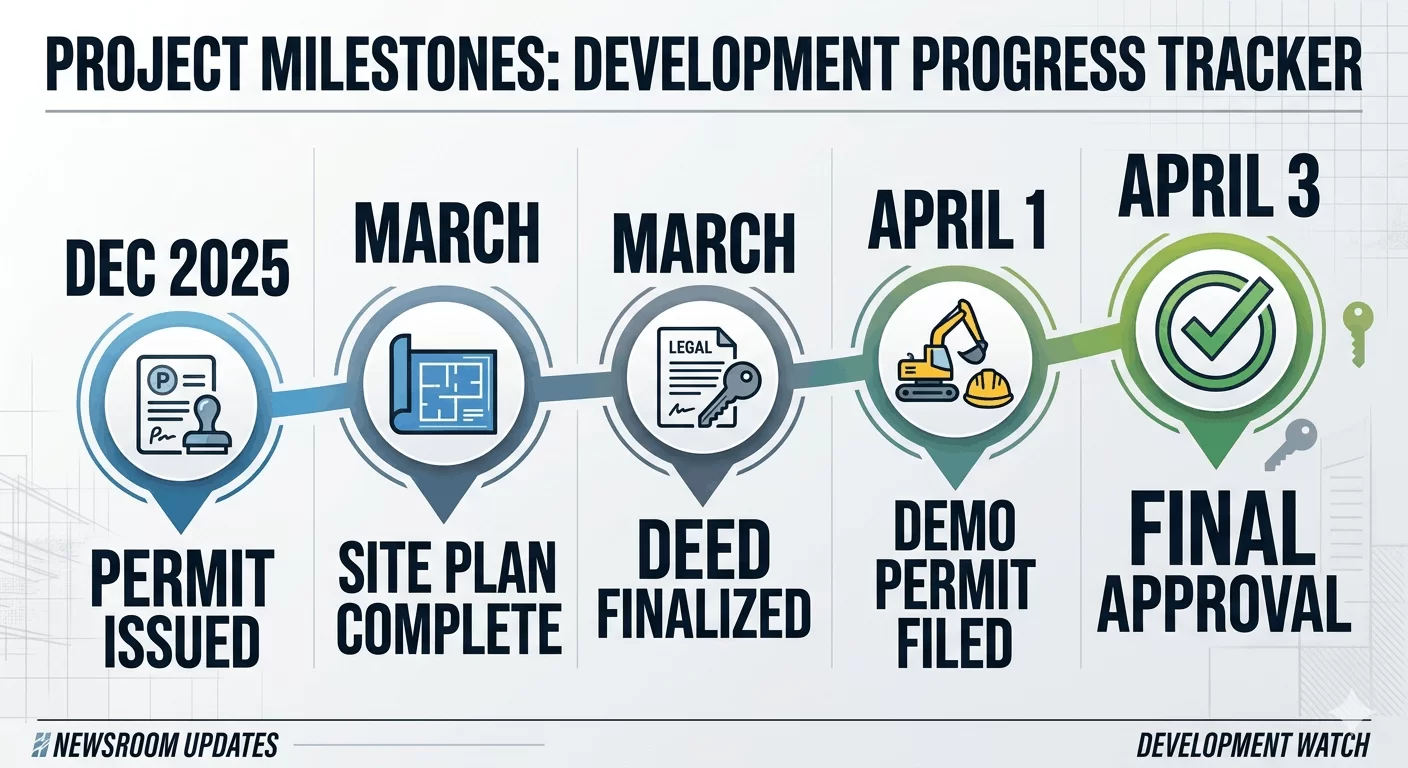
In December 2025, a $610 million buildout permit was filed with the Texas Department of Licensing and Regulation. That’s not a small office refresh. That’s the kind of capital commitment that changes a campus entirely.
On March 19, the City of Austin approved a site plan for electrical infrastructure upgrades – substations, private electrical systems, utility connections across the campus.
The deed recorded March 20. The sale was publicly confirmed March 31.
On April 1 – the very next day – a demolition permit was filed for a 92,430 square foot parking garage on the property. That’s roughly 230 to 280 parking spaces, built around 1998.
The permit was approved April 3. Two days.
For anyone who has dealt with Austin permitting timelines – especially inside the City of Austin – you know that turnaround doesn’t happen by accident. That application was drafted and ready to file before the sale closed. The demolition was part of the plan from day one.
Here’s where it gets interesting.
I was told by someone who claims to have some insider knowledge (not verified) that the plan is roughly 100 employees – and that it will not be a data center… and not chip manufacturing.
I take that at face value.
But here’s what I can’t reconcile: you don’t demolish a 92,000 square foot parking structure to accommodate 100 people. For that headcount, the existing surface parking across a 107-acre campus is more than adequate. The footprint being cleared isn’t for cars. It’s for infrastructure.
And a power plant…
And $610 million in buildout…
And major electrical upgrades.
So if it’s not a data center, and not chip manufacturing – what is it?
I’ve been in the tech space since 2000 and I’ve been watching this local market for over two decades as a resident, investor, and real estate agent. Here’s how I’d rank the realistic possibilities.
Possibility #1: Chip Design
Chip design is completely different from chip manufacturing. Manufacturing requires cleanrooms, water systems, massive greenfield construction. Design is writing the architectural blueprints that tell fabricators what to build. It’s done by engineers at workstations – but those engineers need enormous on-site computing power.
The simulation software that verifies a chip design will actually function requires clusters of servers running continuously. The compute serves the people inside the building directly.
That fits the language in the city permits almost exactly: “computing infrastructure to support an on-site user.”
Here’s the ownership thread worth noting.
The entity that purchased this campus is connected to SoftBank. SoftBank owns approximately 90% of ARM Holdings – the company whose processor architecture runs inside virtually every smartphone, data center, and AI accelerator on the planet.
ARM’s CEO stated publicly in February that Austin is “a rapidly growing center for advanced chip design.” ARM already has over 1,000 employees in Austin.
SoftBank has also been pursuing what Bloomberg reported as Project Izanagi – a $100 billion initiative to develop AI chips to compete with Nvidia, described as working alongside ARM.
100 elite chip architects. Their own power plant. A closed perimeter protecting intellectual property worth hundreds of billions (This also explains closing down the access road to Vandegrift). The parking footprint converted to cooling and electrical infrastructure. $610 million to build out the labs and compute clusters.
It fits.
This is different from a data center in a meaningful way. A data center serves external customers.
A model training lab is where an organization trains its own AI models internally – the compute serves the researchers in the building. Someone doing that work would accurately say it’s not a data center. SoftBank’s CEO has spoken publicly and repeatedly about AGI as his life’s mission. This profile fits the permits. It fits the owner.
SoftBank has been positioning ARM as critical US national security infrastructure. A cleared facility doing classified AI work would have every characteristic we see here – small specialized headcount, absolute secrecy, closed perimeter, independent power infrastructure, carefully neutral permit language. This would explain the level of opacity better than anything else.
Possibility #2: Quantum computing research facility
This is a stretch but worth naming. Quantum computers require extraordinary physical infrastructure – extreme cooling to near absolute zero, vibration isolation, electromagnetic shielding. A 100-person quantum research team would need vastly more physical and power infrastructure than headcount suggests. Several major tech companies have been building dedicated quantum facilities. SoftBank has investments in this space. The parking demolition could create space for the dilution refrigerator systems quantum computing requires.
The problem: quantum computing at this scale doesn’t exist yet commercially. It’s more R&D than operational. Possible but speculative.
Possibility #3: Robotics and physical AI development
SoftBank owns Boston Dynamics. Masayoshi Son has spoken repeatedly about a future of humanoid robots. A facility developing the AI systems that run physical robots would need the same profile – small specialized team, massive compute, purpose-built physical infrastructure.
The 1987 campus was built for industrial R&D with heavy floor loads, which would support physical hardware testing alongside software development.
This is actually an interesting fit because it’s definitionally “computing infrastructure to support an on-site user” – the user being the robots and the engineers developing them – and it’s absolutely not a data center.
Again, this is speculative, but a possibility.
Possibility #4: Defense or intelligence-adjacent AI
SoftBank has been positioning ARM as critical US national security infrastructure. There have been active conversations in Washington about AI systems for defense applications. A cleared facility doing classified AI work would have every characteristic we see here. Small headcount of cleared personnel. Absolute secrecy about operations. Closed perimeter. Own power infrastructure for security reasons. The “computing infrastructure for an on-site user” framing could be deliberate legal language chosen because it technically describes the facility without disclosing its purpose.
This would explain why nobody will talk about it and why the city site plans use such carefully neutral language. Again, speculation…
The honest ranking
If you made me order these by probability given everything confirmed:
- SoftBank AI chip design / ARM architecture center is still most likely because of the direct ownership chain and ARM’s public Austin expansion statements.
- SoftBank proprietary AI model training lab is a close second because it fits the “not a data center” framing most naturally and aligns with Son’s AGI obsession.
- Defense-adjacent AI is third because it explains the secrecy better than anything else but requires assumptions we can’t verify.
- Robotics AI development is fourth, interesting but more speculative.
- Quantum computing is fifth, fascinating but probably too early-stage for this scale of buildout.
Again, None of the above are confirmed, but rather “possibilities”.
Nobody has said any of this on the record. What we have is a permit profile that doesn’t match the “100 employees” narrative, an ownership chain that points somewhere specific, and carefully chosen language from people who know more than they’re saying.
There’s also a reasonable likelihood this is a phased project. What gets described as 100 employees in phase one may look very different in years two and three. Whatever is going in there is probably not finished being designed yet.
Here’s what holds across every scenario I described: the people who work in these facilities are highly compensated specialists – chip architects, AI researchers, defense engineers. They have families. They care about schools. And they want to live near where they work.
Four Points, Steiner Ranch, River Place, Lakeway – we are the closest established, family-oriented communities with strong schools and lake access to what may be one of the most significant tech investments in Austin’s recent history.
For sellers who have been nervous about prices since 2022: the long-term drivers of value in this corridor are intact. If you’ve been waiting for a signal, I’d argue you’re looking at it.
For buyers: the window to get ahead of this is now. When infrastructure investment becomes common knowledge, pricing adjusts to reflect it. Most people in Steiner Ranch still don’t know what’s being built two miles from the neighborhood entrance.
I’m going to keep following this as new permits are filed and new records become public. I’ll update here when there’s something worth sharing.
If you want to talk through what any of this means for your specific situation, I’m always a call or text away.
- Header – aerial of River Place / Lake Austin / 620 corridor at dusk, wide, establishes the geography.
- Mid-article – Project Cosmos permit timeline infographic (Dec → March → April) in clean branded colors.
- Close-out – casual photo of Heather in the neighborhood, reinforcing the neighbor-who-knows angle.
