
Stargate. Orion’s Belt. Cosmos. Terafab.
In the past 90 days, more significant AI and semiconductor infrastructure has been announced, permitted, or purchased within an hour of Four Points and Steiner Ranch than in the previous decade combined. And most people who live here have no idea.
Let me change that.
What Just Happened at Highpoint 2222
 The former 3M campus at RM 2222 and River Place, the one you’ve driven past thousands of times, sold on March 20. The buyer is an entity called SE Cosmos LLC, registered in Texas in October 2025 with an address matching Silicon Valley-based SB Energy’s headquarters. Travis County property records, reported today by Austin Business Journal, confirm the transaction.
SB Energy is one of the largest AI infrastructure developers in the country. They build and operate the physical campuses where AI computing runs. They are a SoftBank company and a partner in the $500 billion Stargate initiative, which is building AI data center infrastructure across the United States.
Here is what makes the Highpoint sale unusual: SB Energy filed a $610 million construction permit with the Texas Department of Licensing and Regulation on December 8, 2025. Three months before the sale closed publicly. They pulled a city of Austin site plan for electrical infrastructure upgrades on March 19, one day before the deed recorded. This was planned and in motion since Q4 of last year. Someone knew this campus was special well before anyone in our neighborhood heard the name Project Cosmos.
Whether Highpoint 2222 specifically will serve as a Stargate node has not been confirmed. Austin Business Journal noted explicitly that remains unclear. What is confirmed is that SB Energy, the company building a $18 billion OpenAI data center in Milam County 90 minutes from here, now owns 107 acres and 1.1 million square feet at the corner of RM 2222 and River Place.
But That Is Just One Piece
Here is the part of this story that most local coverage is missing entirely.
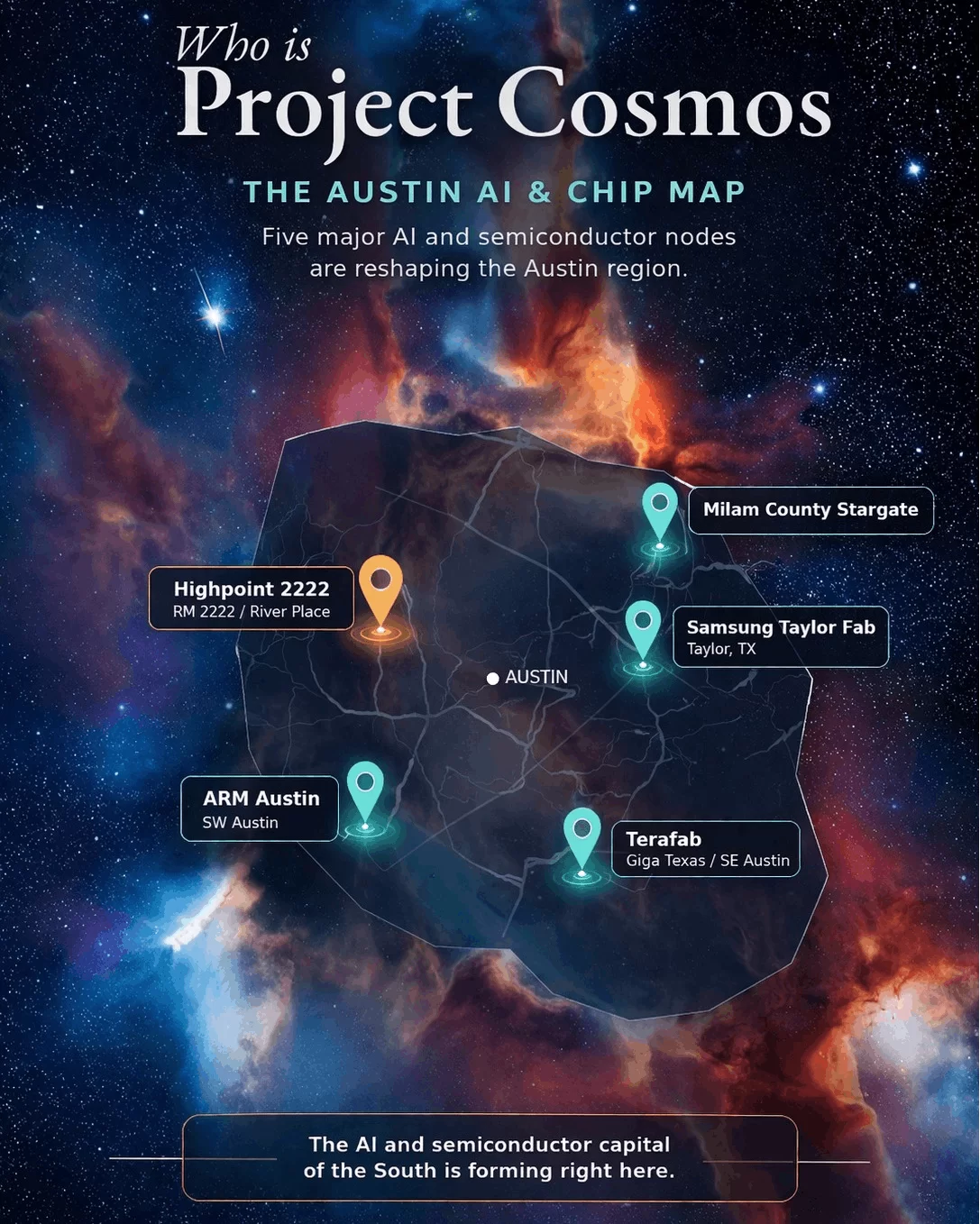
Highpoint 2222 is not an isolated event. It is one node in a cluster of AI and semiconductor investment landing around Austin simultaneously. And when you see them together on a map, the picture is remarkable.
Nine days after SE Cosmos LLC recorded the Highpoint deed, Elon Musk announced Terafab at an event in downtown Austin. Tesla, SpaceX, and xAI are building what Musk called the largest chip manufacturing facility ever attempted, targeting 2-nanometer process technology, at the Giga Texas site in Southeast Austin. Small-batch production of Tesla’s AI5 chip is anticipated in 2026.
Samsung has been building a $17 billion semiconductor fabrication plant in Taylor since 2022, roughly 35 miles from Four Points, with operations expected by the end of this year.
ARM Holdings, the British semiconductor company that designs the chip architecture inside virtually every smartphone on the planet, already has over 1,000 employees in Austin and is expanding its existing southwest Austin office. ARM executives have publicly hinted at a new Austin site in recent months. Multiple sources told Austin Business Journal that ARM was specifically looking at Highpoint 2222 before the SB Energy sale closed. ARM declined to comment.
And Milam County, roughly 90 miles northeast of Austin, is home to both the SB Energy Orion Solar Belt facility that powers Google’s Texas data centers and the $18 billion Stargate data center campus now under construction.
The constellation has a name. Austin is becoming the AI and semiconductor capital of the southern United States.
What This Means for Chip Manufacturing Specifically
I want to be direct about something, because I have been getting questions about whether Highpoint 2222 could become a chip manufacturing facility.
Almost certainly not. And the distinction matters.
True chip manufacturing, the kind Samsung does in Taylor and Musk is attempting at Giga Texas, requires purpose-built cleanrooms, millions of gallons of ultra-pure water daily, and vibration isolation at a scale that no repurposed office building can provide. Every serious fab being built right now is greenfield construction from scratch on large sites with dedicated infrastructure.
What Highpoint 2222 can support is chip design. That is a completely different activity. Chip design means engineers creating the architecture for chips, writing the code that tells fabs what to build. ARM does exactly this. It works perfectly in a renovated campus with excellent power infrastructure, high-speed fiber, and secure facilities. That is precisely what Highpoint offers.
The distinction for our housing market is significant. A chip design campus brings hundreds to thousands of engineers. A data center brings a much smaller permanent operations team. ARM engineers in Austin earn $200,000 to $400,000 in total compensation. They buy homes. They enroll kids in school. They are the demographic that drives demand for $900,000 to $1.4 million homes in Steiner Ranch and Four Points.
Why Our Schools Need to Hear This
LISD is actively discussing closing schools in this feeder pattern based on current enrollment. Steiner Ranch Elementary at roughly 375 students. River Ridge at roughly 345. Vandegrift at around 2,200.
A district making irreversible school closure decisions without modeling what this cluster of AI and semiconductor investment will do to residential demand in this corridor over the next five years is working with dangerously incomplete information.
The Cosmos permit has been in the TDLR public database since December 8. The deed is in Travis County records. Terafab was announced ten days ago. Samsung’s Taylor fab opens this year. These are not projections. They are documented facts. If the residential demand they generate flows into this feeder pattern as expected, the enrollment picture looks very different in 2028 than it does today.
If you have two minutes at the next board meeting, get this on the record.
By the Numbers: How Big Is This Really?
In case you are wondering whether this is genuinely significant or just one building getting attention, here is what the industry data says.
The Austin-San Antonio data center market currently has 7,823 megawatts of planned capacity. That is nearly seven times the current operating capacity of 1,154 megawatts. Of the 615 megawatts actively under construction right now, 96 percent is already pre-leased. This market is not speculative. It is committed.
Ali Greenwood, vice chair at Cushman and Wakefield and part of the firm’s national data center advisory group, said Austin is in the “early innings” of data center growth and that its growth over the next several years will be “very focused on hyperscale and AI” in a way that sets it apart from Dallas, Chicago, and Northern Virginia.
Curt Holcomb, managing director at Jones Lang LaSalle’s global data center solutions practice, said his team predicts Texas will surpass Northern Virginia as the largest data center hub in the world by 2030. The reason: ERCOT’s power grid.
Highpoint 2222 is not a one-off. It is the first piece of a market that industry experts say is just getting started.
What This Means for Your Home Value Right Now
I have sold homes in this corridor for over 20 years. I live in Steiner Ranch. I drive past Highpoint 2222 on the way to swim practice. Let me give you the honest answer.
The confirmed facts support three real estate conclusions.
First, Karlin’s plan to build 1,250 apartments at Highpoint 2222 is almost certainly gone. A data center operator has no use for residential development adjacent to secured AI infrastructure. The removal of that supply from the pipeline is a direct support for values in the surrounding residential market.
Second, confirmed AI infrastructure in a submarket creates a halo effect that attracts surrounding tech investment over time. Apple’s campus reshaped Northwest Austin. Tesla’s arrival moved Southeast Travis County. When major employers confirm a location, other companies follow. That process has started here.
Third, the ARM Holdings question is the most important open variable for near-term residential demand. If ARM confirms a significant presence at Highpoint, expect it to move values in Four Points, Steiner Ranch, and River Place in a measurable way within 18 to 24 months of announcement.
What Does This Mean for Jobs and Our Schools?
The answer depends entirely on what Highpoint 2222 becomes. Here are three honest scenarios based on industry research and confirmed job numbers.
Scenario A is pure SB Energy data center operations. Industry research shows large data centers run on 20 to 30 permanent staff per 100 megawatts. The Cosmos buildout likely supports 50 to 150 permanent operations roles. Good paying technical work, but not the engineering comp that drives $1.2M home purchases. Residential impact on our corridor: roughly 10 to 30 net new households. School-aged children entering the LISD feeder: 5 to 15. Modest.
Scenario B is ARM Holdings as a significant tenant. ARM announced a $71 million Austin expansion in February 2026, adding 320 jobs, with their CEO calling Austin their largest U.S. site. A meaningful ARM presence at Highpoint could bring 500 to 1,500 additional chip design engineers to Austin. These engineers earn $200,000 to $400,000 in total compensation. Roughly 30 to 40 percent would seek housing in this corridor. That projects to 150 to 600 new households and 145 to 660 school-aged children entering the LISD feeder over three to five years.
Scenario C is full campus multi-tenant buildout over time. The Cosmos filing covers 21 percent of the total campus. If SB Energy fills the remaining space over a five to seven year horizon, total employment could reach 2,000 to 4,000 across the campus, projecting 340 to 950 school-aged children into this feeder pattern.
LISD is considering closing schools based on Scenario A assumptions. If Scenario B or C unfolds, those decisions become very difficult to defend. The ARM expansion announcement is already in the public record. It belongs in the LISD board conversation.
This is the most significant concentration of tech investment in our specific corridor since Apple opened its north Austin campus. I am watching it closely and I will update you when the next piece confirms.
