
Most people are still trying to figure out what’s happening in the housing market.
The headlines say things are slow. Uncertain. Mixed.
That’s technically true — at a national level.
But here’s the problem with that narrative: it completely misses what’s happening locally.
The National Picture
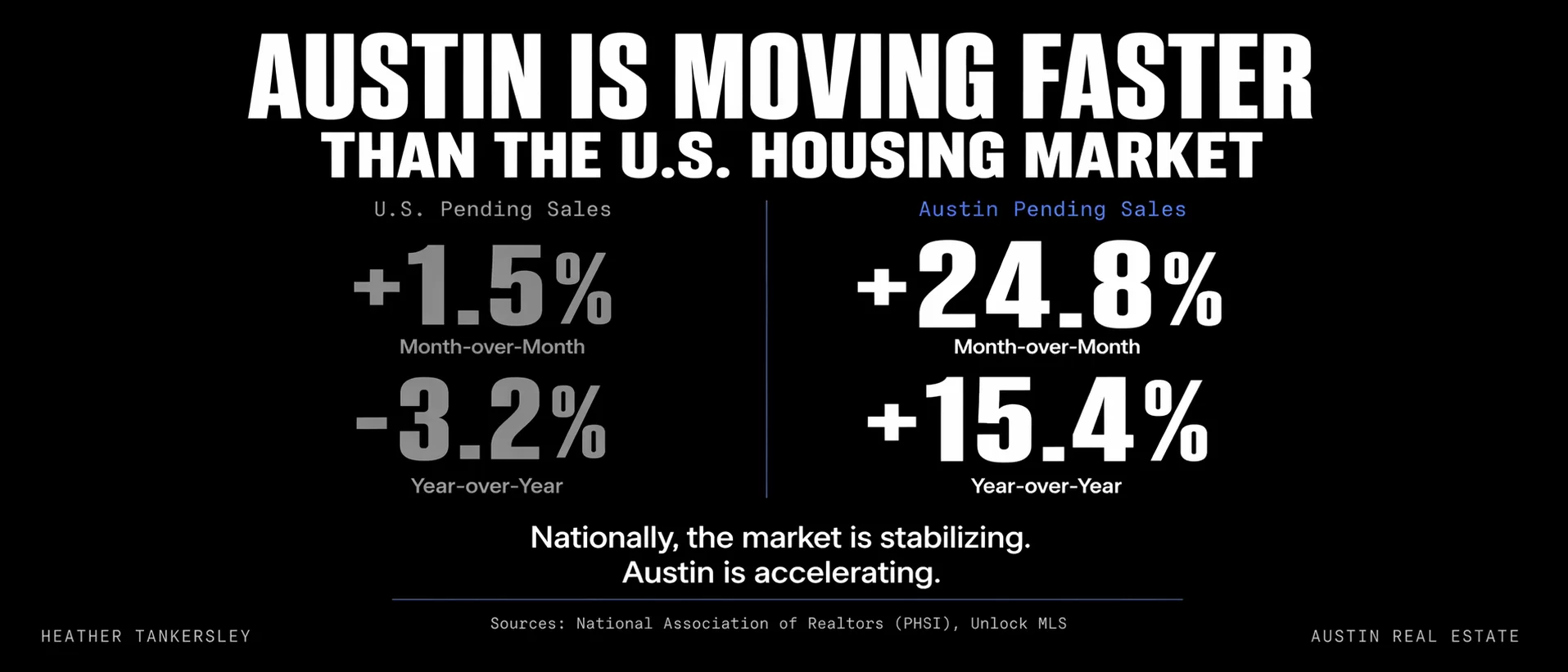
According to the National Association of Realtors, pending home sales rose just 1.5% month-over-month in March. Year-over-year they’re still down 3.2%.
That tells us one thing: buyers across the country are cautious. Watching rates. Waiting. Taking their time.
The Austin Reality
Now let’s look at our market.
According to Unlock MLS, Austin recorded 3,357 pending sales in March — up 24.8% month-over-month and 15.4% year-over-year.
That’s not a slow market. That’s not hesitation. That’s buyers stepping back in.
Why This Matters
Pending sales are one of the most important indicators we have. They don’t show what people say they’re going to do. They show what buyers are actually doing right now.
Contracts being written. Deals being made.
So when you see Austin posting +24.8% month-over-month and +15.4% year-over-year, that’s not noise. That’s momentum.
What This Means for Buyers
You still have leverage.
- More inventory than we’ve had in years
- Nearly half of listings have price reductions
- More time to make decisions
But here’s the shift: you’re not the only one seeing the opportunity. Other buyers are stepping back in. The window isn’t gone — but it’s starting to narrow.
What This Means for Sellers
Demand is there. Homes are going under contract every day.
But the market has changed. Buyers are selective. Strategic. Patient.
The homes winning right now are priced correctly from day one, positioned well against competition, and marketed with intention. The ones that aren’t? They’re sitting.
The Bigger Picture
Nationally, the market is stabilizing. Locally, Austin is accelerating. That gap matters — because that’s where opportunity lives.
FAQs
Austin is best described as a balanced market leaning toward buyers.
We’re sitting around 5.5–6.5 months of inventory, which is the technical definition of balanced—but the behavior of the market tells a different story.
There are more sellers than buyers (roughly 3:1), and nearly half of listings have had price reductions.
👉 What that means in real life:
- Buyers have time, options, and negotiating power
- Sellers can still win—but only with correct pricing + strong positioning
This isn’t 2021 chaos. It’s a strategy market.
Historically, the prime window in Austin is mid-April to early-May.
That timing typically delivers:
- More buyer traffic
- Faster days on market
- Higher list-to-sale price performance
Why? It hits the sweet spot:
- Spring demand is peaking
- Families are planning summer moves
- Inventory hasn’t fully flooded yet
👉 But here’s the nuance most agents miss:
In this market, timing matters less than pricing + presentation.
A perfectly timed listing that’s overpriced will still sit.
Yes—but context matters.
Austin has been in a controlled correction since the 2022 peak:
- Peak (2022): ~$550K
- 2026: roughly $440K median
That’s about a 20–25% adjustment from peak, but:
- Recent declines are now small (around ~1–5% annually)
- The pace of decline is slowing significantly
👉 Translation:
- The big drop already happened
- We’re likely moving toward stabilization—not a crash
This is a reset, not a collapse.
Pending sales are homes that are under contract but not yet closed.
They matter because they’re the most real-time indicator of demand.
Closed sales tell you what already happened.
Pending sales tell you what’s happening right now.
👉 Why you should care:
- Rising pending sales = buyer demand increasing
- Falling pending sales = market slowing
- Strong pendings with longer DOM = negotiation market
In Austin, homes are going pending in about ~53 days on average, which shows buyers are active—but deliberate.
Short answer: If you’re financially ready, this is one of the best windows we’ve had in years.
Here’s why:
- More leverage than we’ve seen in a decade
- More inventory
- Fewer bidding wars
- Negotiation is back
- Prices already corrected
- Down ~20% from peak
- Smaller declines now → closer to the bottom
- Less competition = better decisions
- You can inspect, negotiate, and think
- Not panic-buying in 24 hours
👉 The only caveat:
Interest rates still matter. If rates drop, competition will spike fast.
The Bottom Line
Austin in 2026 isn’t about guessing the market.
It’s about understanding leverage:
- Buyers win with strategy
- Sellers win with positioning
- Everyone loses if they rely on 2021 playbooks
